

.svg)
Introduction
Technical debt. Even if you don't know the name you are likely aware of its manifestations. It's a phrase derived from the software world but that has applications everywhere, including in Medical Affairs .
It can be thought of like financial debt: When you take out a loan, you get something useful today in exchange for paying interest later. Technical debt works the same way, except in return for the up-front benefit, you also get a whole host of non-financial repayments: time, resource wastage, lost value, opportunity cost, and a whole host of other things. Often the quicker, the dirtier the loan, the higher the repayments.
In the software world, the cause is often code. A development team may write some sub-par code now quickly in order to release a new feature. The feature gets released, great, however it doesn't end there. That sub-par code is now part of the ecosystem. It must require maintenance, time to be trained on it, resources to attend to it. It also forms dependencies, meaning in order to improve other features, this sub-par code must first be attended to. It slows the whole thing down.
In a Medical Affairs context, this is less about the individual code and more about the technology, the systems, the tools, that are acquired. If you replace sub-par code above with a sub-par medical education portal you can quickly see the impact. You get a quick hit of a live website, but now you have an unintegrated platform where you have to spend hours and days to maintain, to pull manual reports, to export data from one system to another, to mitigate compliance risks.
Add this quick medical education platform on top of the unintegrated insights platform on top of the cheap webinar platform, and you can see how this debt very quickly adds up, impacting your ability to deliver value.
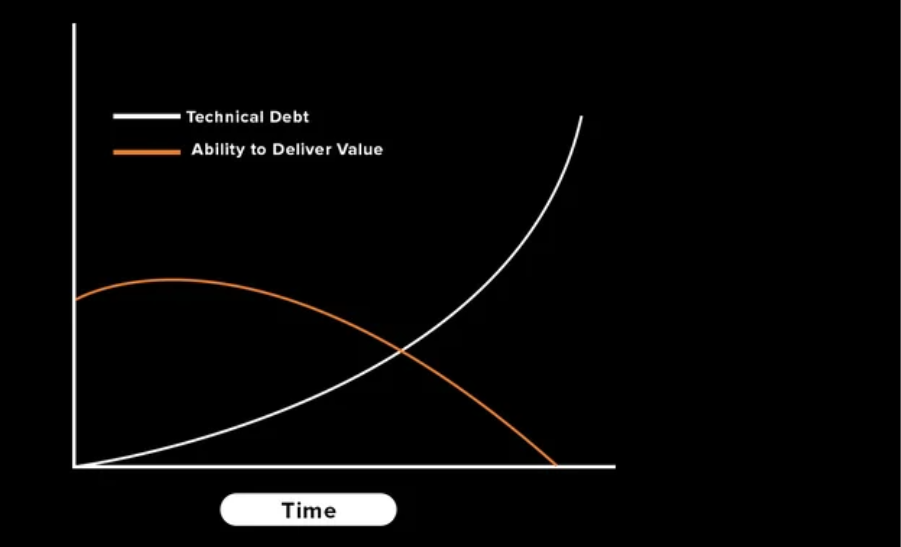
Source: https://insights.daffodilsw.com/blog/technical-debt
In a world where Medical Affairs is being expected to do more in the technology space - this problem isn't going away, in fact it's going to get more expensive to maintain.

What are the typical causes of technical debt?
As always, the causes are not necessarily clear cut from the outset, but obvious once you are made aware of them. And for some of the common causes we can look back to the software world. Undoubtedly, you'll recognise that a lot of these in your daily Medical Affairs context as well.
- Inexperience: If the people leading on the approach are a) unaware of technical debt and b) unaware of the complexities, this often leads to over-complicated, short-term, solutions that an experienced counterpart could foresee.
- Unclear expectations / requirements: Broad terms such as "Customer-focused" means different things to different people. Which customer? Is it a consultant, or a nurse? Will they be given an induction? Failing to define this up-front means building complex systems that work for everyone and also no one.
- Lack of planning: Failure to plan for the long-term or scale mean that everything requires a quick solution. To the unprepared, everything is an emergency. If everything is an emergency, quick is the default.
- Siloed communication: Poor collaboration across teams leads to duplication of work, poor integration, misaligned project goals.
- Poor documentation: Maintaining system requires different people with different interpretations. When it isn't clear what's been done and how to work with it, duplication, workarounds, and changes happen, which add to the complexity.
- Time constraints: When the focus is constantly on short-term delivery over long-term value creation, it becomes a habit to prioritise quick over quality.
You can quite quickly see how these caused are translated into the reality for Medical Affairs right now, causing a perfect storm:
- Launches are getting smaller and more numerous, meaning a constant flywheel of time pressures.
- When formulating the medical strategy and plan, technology is often an afterthought. And hence, by the time it becomes clear it's needed, it's too late. The quick solution seems the easiest one.
- Technology is not on the curricula of the average Medical Affairs onboarding, and as such, knowing about the importance of CRM integration is not likely to be front of mind.
- The tech solution landscape for medical is getting louder and louder and busier and busier. It's becoming harder and harder to distinguish between those which will add value with limited debt, and those that will do the opposite.
Not all debt is created equally
To focus on an important thing here, not all technical debt is negative. For one, it is simply inevitable - Nearly every decision has a long-term cost associated with it. Plus, there is positive technical debt. For example with a new product launch. Here, moving quickly is absolutely critical in order to get things in order before competitors. Quickly spinning up a webinar platform and landing page is a great move. When done deliberately, knowing that there could be debt associated, this webinar platform is then integrated after the fact, before the next webinar goes live.
The below quadrant, popularised by Martin Fowler explains the different types well. The differences in good and bad come back to deliberateness and intent:
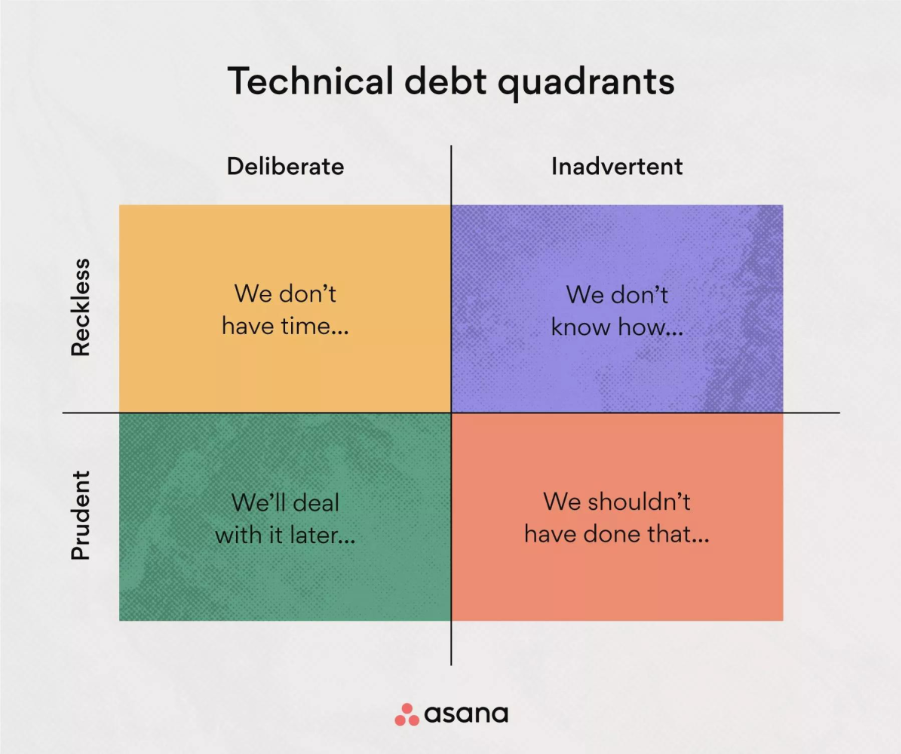
Source: https://asana.com/resources/technical-debt
And the impact of this? If you keep taking out more and more technical debt, it will rear its invisible head. Not in an easily identifiable way. But in complex, often hidden ways:
- Lost efficiency
- Opportunity cost
- Duplication
- Compliance concerns
- Data errors
- Burnout.
- And any costs to pay yourself out of the current situation
What does good look like?
As always, that's all well and good but what does good look like in a Medical Affairs context. There are three key areas:
- Awareness: Like a therapy session - the first step is awareness. Without awareness there's no chance. Technical debt keeps accumulating behind the scenes. Accepting its inevitability changes the conversation. It slows us down and allows us to ask the right questions up-front. It moves the debt from a powerful, intangible force to one which is controllable.
- Proactivity: The next step is to be proactive. Get ahead. When everything is an after-thought, it’s no surprise you have to rush your decision making. Instead, build forward thinking into your planning. Consider the platform or tech requirements as part of your Medical Strategies and plans. Got a big webinar series coming up? Start planning the platform you'll use in plenty of time. Know you'll have to take a shortcut and won't have time to do the integration? Plan to review this and integrate with your CRM at a later date.
- Reactivity: Finally, there's the reactive element. Considering that there is already plenty of technical debt, increasing as more tech is onboarded, it's important to review at a regular basis what's going on. What tools are causing an amazing amount of manual work arounds? Where do different teams use different tools? Pharma is great at launching things, but not so great at looking in the rear view mirror for where things can be stopped.
Always read the small print
To wrap up, the point of this is not to preach that you should never make a fast decision. It's that you should never make a fast decision blindly.
As Medical Affairs begins to accumulate more and more technical capabilities, aligned to its increase in strategic importance, it needs to be aware of the impact of these technology decision. The more debt that builds up, the more that your ability to create value is impacted. So the ask:
- Think about how much debt your Medical Affairs team is already carrying?
- And ask how you'll manage it going forwards?
Remember: Just like a loan, before taking out any technical debt, be sure to always read the small print…
Feedback
Let me know your thoughts. Does any of this ring true? Has this given you a new phrase for a term that you have been aware of inherently?

