
The one (simple) fix to maximise the impact of any Medical Affairs department
It’s been said that the heterogeneity of Medical Affairs departments between companies (and even within companies) is magnitudes greater that that observed between R&D and Marketing departments in Pharma and Biotech.
In fact, some medical team members find the Medical Affairs department that they join (when moving between roles) to be nearly unrecognisable from the one that they just left. In turn, Senior management can be found scratching their heads about how it is that their understanding of what Medical Affairs does has been turned on its head by seeing a department that doesn’t behave like anything they’ve experienced before.
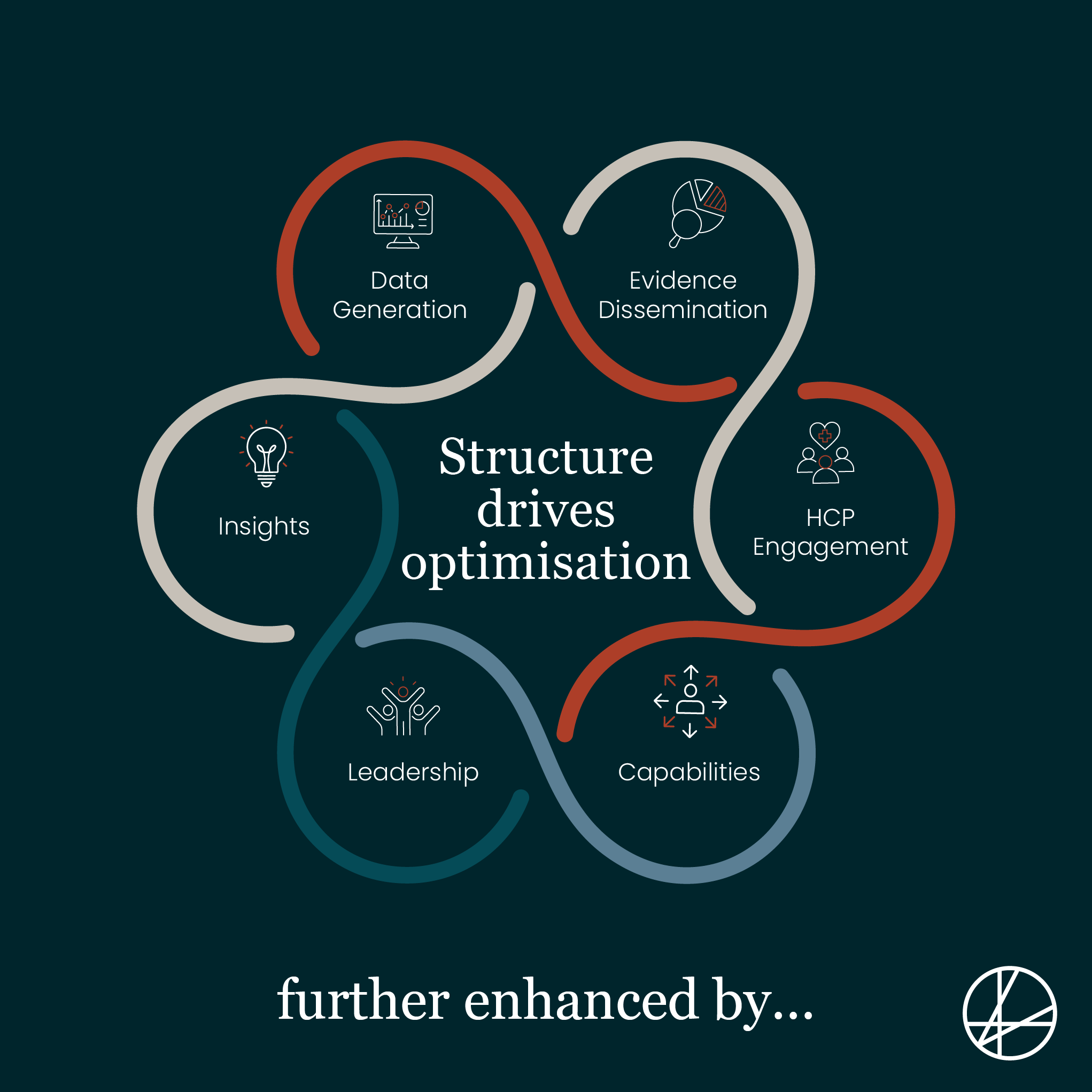
There’s an easy explanation for this – Medical Affairs is a multi-faceted function that drives the uptake of new medicines into routine clinical practice using a variety of only-loosely related practices: strategic leadership (both to medicines development & commercialisation), new data generation, evidence dissemination, external engagement, insights gathering and capabilities building to name but a few.
What few acknowledge is that when Medical Affairs works well, it draws on these diverse practices in varying amounts and in a variety of permutations to deliver whatever the medicine, the company, the clinical community and the patient groups need at any given time.
This means that to work at their best, Medical Affairs departments must shape & deploy themselves differently for every medicine, every indication and every phase of development & commercialisation that they are faced with.
It therefore stands to reason that the most effective Medical Affairs departments would be prospectively designed to deliver what is needed for the medicine – taking account of such variables as:
Therapy area & Company heritage in that therapy area
Complexity and clinician-familiarity of the medicine’s MoA
Product profile (safety, efficacy, unique attributes)
Number and type of clinicians involved in the use of the medicine
Clinical service delivery and geographical spread
Competitive environment
Budget
Unfortunately, this prospective design piece of Medical Affairs departments is commonly short-circuited or missed completely – we call this the “Pre-pack Problem” – an assumption that the newly forming Medical Affairs department that is needed can be based on:
A previously-run department, or
A generic resourcing model of Head Office Medical Advisors/Directors and field medical associates (MSLs), or
A finger-in-the-air guess at what might work best
This approach leads to a poor fit between the unique needs of the medicine and the form-&-function of the new Medical Affairs department – leading to:
Low impact
Wasted resource
Internal frustration
Question marks arising over the value delivered for what is a very expensive resource commitment
It’s at this point that someone invariably asks “How are we measuring Medical Affairs?”. Cue a protracted period of hand-wringing as the department attempts to reverse engineer a list of metrics and KPIs into a department that was never designed for the tasks at hand.
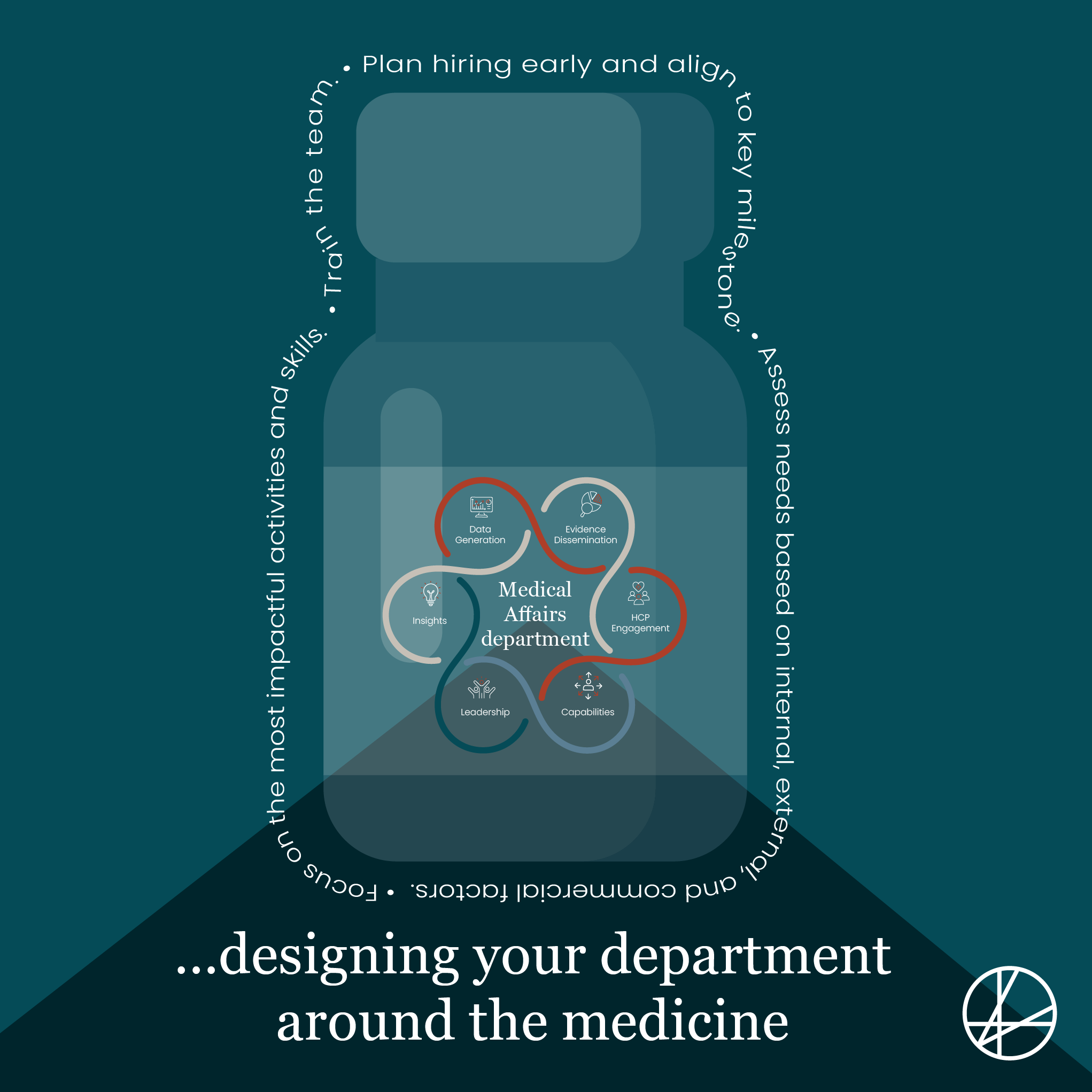
A better way to approach this is to prospectively design the department for the unique challenges it will face. This is likely to be along the following lines:
Understand the timings and stage-gates for the investment in the Medical Affairs team build-out. The company must avoid the temptation to delay any hiring until a key milestone (e.g. Phase 3 recruitment starts) only to panic and demand a fully staffed and highly functional Medical Affairs department three months later.
Intentionally analyse the need for the Medical department based on both an internal and external situational analysis, aligned to the commercial needs of the medicine and the Brand Plan.
Define the most impactful and highest leverage activities and skillsets that a Medical Affairs department can utilise to support the unique needs of the medicine.
Author a ‘MA Department Design Plan’ that codifies the findings and plans – concluding with a departmental design, supported by a hiring & training plan (The Plan).
Hire, train, deploy and retain the new MA department in-line with ‘The Plan’.
Thus, the ‘MA Department Design Plan’ might have a Table-of-Contents that looks something like this:
Product profile and anticipated clinical use
Situational analysis
a. Internal
i. Key product milestones
ii. Strategic imperatives (from the commercial and medical strategies)
iii. Cross-functional departmental build plans
b. External
i. Competitive intelligence and competitor milestones
ii. Clinician, prescriber and payor needs
iii. Patient needs
Department Plan
a. MA Department design
b. MA hiring plan (and timelines)
c. MA training plan
Resourcing budget
a. Costs and timelines for the build
RACI
a. Assigned responsibilities for how the build will be managed with the accountability sitting with the VP Medical Affairs/TA Head – and the first thing they should undertake as they take on the new role.
The implications of undertaking this piece of work should be acknowledged:
This is a substantial piece of work
It is best done before any hiring takes place at all
It will likely result in a Medical Affairs department that doesn’t look-like or behave-like other Medical Affairs departments that have been seen before, even within the same company and therapy area. That’s because the unique characteristics of the medicine at-hand have never been seen before.
The most highly valued Medical Affairs departments deliver the greatest impact because they use a variety of differing skillsets to deliver whatever is most needed and gives greatest leverage at any given time.
They are designed, hired-for, trained and deployed for the specific purpose that makes them the most valuable thing they can be to the medicine, the company, clinicians and patients.
Admittedly – this is only a ‘simple fix’ if this is the first thing that’s done and before any hiring starts (missing this step in the early days isn’t something that’s easily undone, but not impossible – and something for a later post), but if done correctly the outcome is a high-performance Medical Affairs team that delivers unrivalled impact in all the specific ways that the Company needs them to.
LUCENT works with Medical Affairs leaders to design and optimise their teams, maximising the value and impact that Medical can have in bringing a new medicine to market.
Authored by:
Dr. Matthew Goodman MB.ChB, MFPM, DPM, FRSM
CEO, LUCENT
To implement discuss optimising your Medical Affairs department, contact Matthew Goodman or Trevor Brett.